0
Sale!

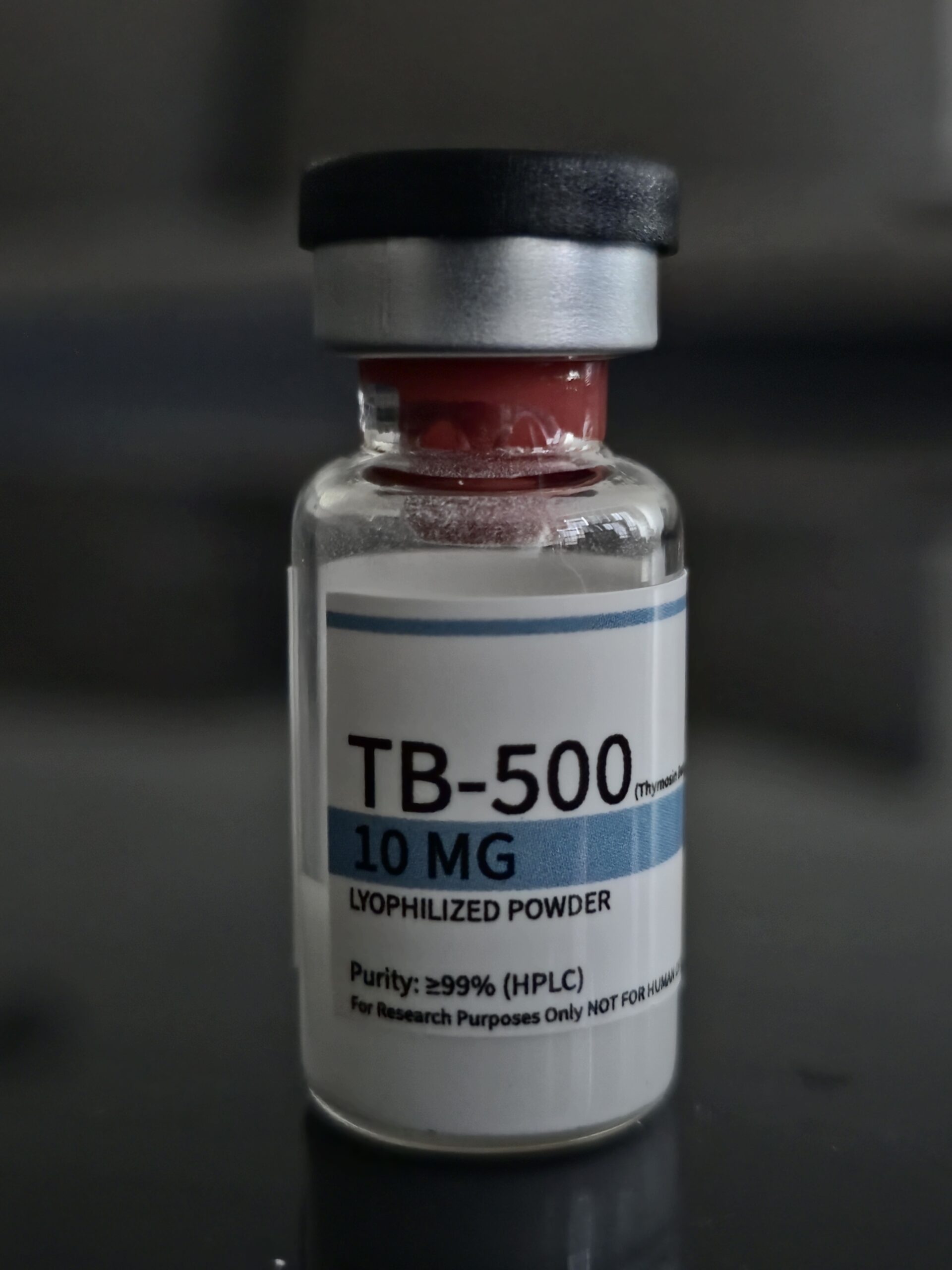
ZentraBio™ – TB-500 – 10 mg
Original price was: €66.00.€36.00Current price is: €36.00.
TB-500 — Research Peptide
Overview
TB-500 is a synthetic peptide derived from the actin-binding region of Thymosin Beta-4 (Tβ4). It represents a short active fragment of the larger 43-amino-acid thymosin beta-4 protein, which plays roles in tissue repair, cell migration, and angiogenesis.
Research involving the parent molecule Thymosin Beta-4 suggests involvement in:
-
wound healing
-
connective tissue repair
-
angiogenesis
-
anti-fibrotic signaling
-
cytoskeleton regulation through actin binding
Because TB-500 represents the LKKTETQ active sequence, much of its proposed biological activity is extrapolated from Thymosin Beta-4 research literature.
Description
TB-500 — Research Peptide
Product Description
TB-500 is a synthetic peptide derived from the actin-binding region of Thymosin Beta-4 (Tβ4). It represents a short active fragment of the larger 43-amino-acid thymosin β4 protein, believed to retain several of the parent molecule’s regenerative signaling properties.
The peptide is widely studied in experimental models related to:
-
connective tissue repair
-
angiogenesis (formation of new blood vessels)
-
cell migration
-
anti-fibrotic signaling
-
wound healing processes
Unlike the full Thymosin Beta-4 protein, TB-500 represents a smaller functional domain believed to interact with actin cytoskeleton regulation, which plays an important role in cell movement and tissue remodeling.
Most available data for TB-500 comes from preclinical studies or extrapolation from Thymosin Beta-4 research, which contains a much larger body of literature.
Verified references
-
TB-500 identification / active-site background: https://pubmed.ncbi.nlm.nih.gov/23084823/
-
Active-site review of Tβ4 fragments including LKKTETQ: https://pubmed.ncbi.nlm.nih.gov/20179146/
-
Review of thymosin β4 functions in repair/regeneration: https://pmc.ncbi.nlm.nih.gov/articles/PMC8724243/
Key Research Characteristics
Compound: TB-500
Parent molecule: Thymosin Beta-4
Functional region: Actin-binding domain
Peptide fragment: amino acids 17–23 of thymosin beta-4
Alternative name: N-acetyl-LKKTETQ
Primary research areas include:
-
wound healing models
-
tissue regeneration
-
angiogenesis signaling
-
anti-fibrotic activity
-
connective tissue repair
Verified references
-
TB-500 / Ac-LKKTETQ background: https://pubmed.ncbi.nlm.nih.gov/38382158/
-
Active-site fragment review: https://pubmed.ncbi.nlm.nih.gov/20179146/
-
Actin-binding site mapping in Tβ4: https://pubmed.ncbi.nlm.nih.gov/8617195/
Evidence Base
The scientific literature surrounding TB-500 itself is limited, with only a small number of direct studies available.
However, Thymosin Beta-4, the parent molecule, has over 1,000 scientific publications, many of which describe regenerative and cytoprotective effects that are hypothesized to relate to the active fragment used in TB-500.
Because TB-500 is a synthetic fragment, its pharmacology is often interpreted through mechanistic overlap with thymosin β4 signaling pathways.
Verified references
-
TB-500 detection / background paper explicitly noting limited direct biological documentation: https://pubmed.ncbi.nlm.nih.gov/38382158/
-
Tβ4 active-site review: https://pubmed.ncbi.nlm.nih.gov/20179146/
-
General Tβ4 review: https://pmc.ncbi.nlm.nih.gov/articles/PMC8724243/
Experimental Exposure Ranges (Educational Context Only)
⚠️ These values represent experimental discussions and research contexts.
They are not medical guidance.
Soft tissue research contexts
-
500 mcg – 1 mg once or twice daily
-
Total daily exposure 500 mcg – 2 mg
These exposure levels are commonly discussed in experimental connective-tissue healing models.
Alternative high-dose experimental ranges
Some protocols discussed in research communities involve:
-
5–10 mg every 5–7 days
These ranges are derived primarily from animal models and extrapolated experimental protocols.
Verified references for research context / limitations
-
Direct TB-500 metabolism / rat urine paper: https://pubmed.ncbi.nlm.nih.gov/38382158/
-
Equine detection paper for TB-500: https://pubmed.ncbi.nlm.nih.gov/23084823/
-
WADA-funded TB-500 metabolism project summary: https://www.wada-ama.org/en/resources/scientific-research/investigation-vitroex-vivo-tb-500-metabolism-synthesis-relevant
Expanded Research Overview
(Scientific background and mechanisms)
Molecular Origin
TB-500 originates from the actin binding region of Thymosin Beta-4, a naturally occurring protein found in many mammalian tissues.
Thymosin Beta-4 consists of 43 amino acids and plays roles in:
-
cytoskeletal organization
-
cell migration
-
angiogenesis
-
wound healing
The synthetic fragment TB-500 represents the core active sequence thought to mediate many of these functions.
Verified references
-
Tβ4 active-site review: https://pubmed.ncbi.nlm.nih.gov/20179146/
-
TB-500 / LKKTETQ doping analysis background: https://pubmed.ncbi.nlm.nih.gov/23084823/
-
Tβ4 actin binding site mapping: https://pubmed.ncbi.nlm.nih.gov/8617195/
Mechanistic Profile
Actin Binding and Cytoskeleton Regulation
The primary biological activity of TB-500 relates to actin binding.
Actin is a key structural protein forming the cytoskeleton of cells, which controls:
-
cell shape
-
cell movement
-
intracellular transport
-
tissue repair processes
By interacting with actin pathways, TB-500 is believed to promote:
-
cell migration
-
structural remodeling
-
tissue regeneration signaling
Verified references
-
Actin-binding site mapping in Tβ4: https://pubmed.ncbi.nlm.nih.gov/8617195/
-
TB-500 / active region identification: https://pubmed.ncbi.nlm.nih.gov/23084823/
-
Active-site review: https://pubmed.ncbi.nlm.nih.gov/20179146/
Cell Migration Signaling
In vitro studies demonstrate that TB-500 can stimulate migration of several cell types, including:
-
keratinocytes
-
endothelial cells
-
fibroblasts
Cell migration is a fundamental process in wound healing, allowing repair cells to reach damaged tissue.
Verified references
-
Tβ4 wound-healing paper showing keratinocyte migration, collagen deposition, angiogenesis: https://pubmed.ncbi.nlm.nih.gov/10469335/
-
Diabetic / aged wound-healing paper showing LKKTETQ fragment promoted repair comparable to parent molecule: https://pubmed.ncbi.nlm.nih.gov/12581423/
-
Active-site review: https://pubmed.ncbi.nlm.nih.gov/20179146/
Angiogenesis
Experimental data suggests TB-500 may promote angiogenesis, the formation of new blood vessels.
Angiogenesis is essential for tissue recovery because it allows:
-
delivery of oxygen
-
delivery of nutrients
-
removal of metabolic waste
This process is critical in:
-
connective tissue repair
-
ischemic injury models
-
wound healing environments
Verified references
-
Tβ4 wound-healing / angiogenesis paper: https://pubmed.ncbi.nlm.nih.gov/10469335/
-
Active-site review noting LKKTETQ promotes angiogenesis: https://pubmed.ncbi.nlm.nih.gov/20179146/
-
Tβ4 vascular review: https://ora.ox.ac.uk/objects/uuid:ab536790-9774-4f42-b794-13cf7398aba6/files/m54dfc6902dab13d6cd6f551b42f8f134
Anti-Fibrotic Activity
Animal and cell models suggest TB-500 may demonstrate anti-fibrotic effects, meaning it may help regulate scar tissue formation.
Fibrosis occurs when excessive collagen is deposited during healing, producing stiff, dysfunctional tissue.
TB-500 appears to influence pathways that regulate:
-
collagen deposition
-
fibroblast activity
-
extracellular matrix remodeling
This mechanism is thought to support more organized tissue repair.
Verified references
-
Tβ4 review covering reduced scar formation / fibrosis: https://pmc.ncbi.nlm.nih.gov/articles/PMC8724243/
-
Tβ4 post-MI paper showing reduced interstitial collagen fraction and improved cardiac remodeling: https://pmc.ncbi.nlm.nih.gov/articles/PMC4187393/
-
Recent cardiac remodeling / antifibrotic paper: https://www.mdpi.com/1422-0067/26/9/4131
Preclinical Research Observations
Studies using TB-500 in laboratory models have reported effects such as:
-
accelerated wound closure
-
increased keratinocyte migration
-
improved collagen organization
-
enhanced angiogenesis
-
reduction in fibrotic scar tissue
One experimental setup applied 0.01–0.05% topical TB-500 / LKKTETQ-related wound formulation logic to wound sites for 10 days, producing faster healing relative to control groups.
These outcomes were comparable to those observed with thymosin beta-4.
Verified references
-
Direct diabetic / aged wound-healing paper with LKKTETQ fragment comparable to parent molecule: https://pubmed.ncbi.nlm.nih.gov/12581423/
-
Foundational Tβ4 wound-healing paper: https://pubmed.ncbi.nlm.nih.gov/10469335/
-
Dermal healing review: https://pubmed.ncbi.nlm.nih.gov/27450738/
Pharmacokinetics
Precise pharmacokinetic data in humans is limited.
Estimated properties include:
Estimated half-life:
approximately 24–36 hours (hypothesized)
The parent protein Thymosin Beta-4 has a serum half-life of approximately 1.8–2.1 hours, but structural modification of TB-500 may extend functional activity.
Direct human pharmacokinetic data remains limited.
Verified references
-
TB-500 metabolism / metabolites in vitro and rats: https://pubmed.ncbi.nlm.nih.gov/38382158/
-
Equine plasma / urine detection paper: https://pubmed.ncbi.nlm.nih.gov/23084823/
-
WADA metabolism project summary: https://www.wada-ama.org/en/resources/scientific-research/investigation-vitroex-vivo-tb-500-metabolism-synthesis-relevant
Detection and Metabolism
Animal models suggest TB-500 metabolites may be detectable for relatively short periods.
Examples include:
Horse model
-
metabolites detected 9–11 hours
Rodent models
-
metabolites detected up to ~48–72 hours
These findings suggest rapid metabolism by peptidase enzymes.
Verified references
-
Equine detection study: https://pubmed.ncbi.nlm.nih.gov/23084823/
-
TB-500 metabolite study in rats: https://pubmed.ncbi.nlm.nih.gov/38382158/
-
WADA project summary: https://www.wada-ama.org/en/resources/scientific-research/investigation-vitroex-vivo-tb-500-metabolism-synthesis-relevant
Research Applications
TB-500 is most frequently investigated in experimental models involving:
Connective Tissue Injury
-
tendon damage
-
ligament injury
-
muscle tears
-
wound healing
These tissues typically heal slowly due to limited vascular supply.
Verified references
-
Direct LKKTETQ / wound repair in aged and diabetic mice: https://pubmed.ncbi.nlm.nih.gov/12581423/
-
Tβ4 wound-healing / keratinocyte migration / collagen deposition paper: https://pubmed.ncbi.nlm.nih.gov/10469335/
-
Dermal healing review: https://pubmed.ncbi.nlm.nih.gov/27450738/
Cardiovascular Research
Experimental research involving Thymosin Beta-4 signaling pathways has suggested potential effects on:
-
endothelial cell migration
-
vascular repair
-
ischemic injury recovery
However, these mechanisms are largely derived from Tβ4 studies rather than TB-500 itself.
Verified references
-
Tβ4 prevents cardiac rupture / improves function post-MI: https://pmc.ncbi.nlm.nih.gov/articles/PMC4187393/
-
Tβ4 treatment after myocardial infarction: https://pmc.ncbi.nlm.nih.gov/articles/PMC3664360/
-
Tβ4 promotes survival and angiogenesis of EPCs in infarcted myocardium: https://pubmed.ncbi.nlm.nih.gov/28440414/
Nervous System Models
Some experimental work indicates thymosin beta-4 signaling may support neurite growth and nerve repair.
TB-500 may theoretically influence similar pathways due to shared active domains.
Verified references
-
General Tβ4 review with CNS / regeneration coverage: https://pmc.ncbi.nlm.nih.gov/articles/PMC8724243/
-
Tβ4-derived peptides and neuroinflammation (newer preclinical work): https://www.sciencedirect.com/science/article/abs/pii/S1567576925020867
Human / Clinical Trial Context
Direct TB-500 human clinical trials have not been established.
However, Thymosin Beta-4 / RGN-259 has entered clinical development in ophthalmology.
Verified trials / studies
-
Dry eye Phase III trial listing: https://clinicaltrials.gov/study/NCT02974907
-
Earlier dry eye trial listing: https://clinicaltrials.gov/study/NCT01387347
-
Phase II dry-eye publication: https://pubmed.ncbi.nlm.nih.gov/26056426/
-
Severe dry eye publication: https://pubmed.ncbi.nlm.nih.gov/25826322/
-
Neurotrophic keratopathy Phase III publication: https://pubmed.ncbi.nlm.nih.gov/36613994/
Limitations of Current Evidence
A critical scientific consideration is that direct TB-500 research remains limited.
Key points include:
-
Only a small number of direct TB-500 studies exist
-
Most mechanistic understanding derives from Thymosin Beta-4 research
-
Human clinical trials for TB-500 have not been conducted
Therefore, conclusions regarding efficacy should be interpreted cautiously.
Verified references
-
Direct TB-500 paper explicitly stating the biological effects of TB-500 itself are not documented to the same extent: https://pubmed.ncbi.nlm.nih.gov/38382158/
-
Active-site / fragment review: https://pubmed.ncbi.nlm.nih.gov/20179146/
-
Tβ4 review: https://pmc.ncbi.nlm.nih.gov/articles/PMC8724243/
Regulatory Status
TB-500 is not currently approved as a pharmaceutical medication.
The compound is commonly categorized as a research peptide.
Because of limited clinical data, many regulatory frameworks restrict its medical use.
Verified references
-
Equine anti-doping analytical paper: https://pubmed.ncbi.nlm.nih.gov/23084823/
-
WADA metabolism project summary: https://www.wada-ama.org/en/resources/scientific-research/investigation-vitroex-vivo-tb-500-metabolism-synthesis-relevant
Safety Considerations
Because controlled human trials are limited, long-term safety data remains incomplete.
Important considerations include:
-
unknown long-term effects
-
limited pharmacokinetic data in humans
-
absence of large-scale clinical trials
Verified references
-
Direct TB-500 metabolism / wound-healing assay paper: https://pubmed.ncbi.nlm.nih.gov/38382158/
-
Tβ4 review: https://pmc.ncbi.nlm.nih.gov/articles/PMC8724243/
-
Tβ4 ophthalmic clinical safety context: https://pubmed.ncbi.nlm.nih.gov/26056426/
Summary Perspective
TB-500 represents a synthetic active fragment of thymosin beta-4 with promising biological properties in experimental models.
Research suggests potential involvement in:
-
connective tissue repair
-
angiogenesis
-
cell migration
-
anti-fibrotic tissue remodeling
However, most of the scientific foundation originates from the broader thymosin beta-4 research field rather than TB-500 itself.
Further clinical studies are required to determine the peptide’s full therapeutic potential.
Verified references
-
TB-500 metabolism / limitations paper: https://pubmed.ncbi.nlm.nih.gov/38382158/
-
Tβ4 review: https://pmc.ncbi.nlm.nih.gov/articles/PMC8724243/
-
Active-site fragment review: https://pubmed.ncbi.nlm.nih.gov/20179146/
Related products
-
Sale!
ZentraBio™ Retatrutide – 4 x 5 mg Vial
Original price was: €208.00.€173.00Current price is: €173.00. Add to cart Compare -
Sale!
ZentraBio™ – BPC-157 – 10 mg
Original price was: €46.00.€36.00Current price is: €36.00. Add to cart Compare -
Sale!
ZentraBio™ Retatrutide – 5 mg Vial
Original price was: €61.00.€48.00Current price is: €48.00. Add to cart Compare -
Sale!
ZentraBio™ Retatrutide – 10 x 10 mg Vial
Original price was: €810.00.€660.00Current price is: €660.00. Add to cart Compare
Reviews
There are no reviews yet.