0
Sale!

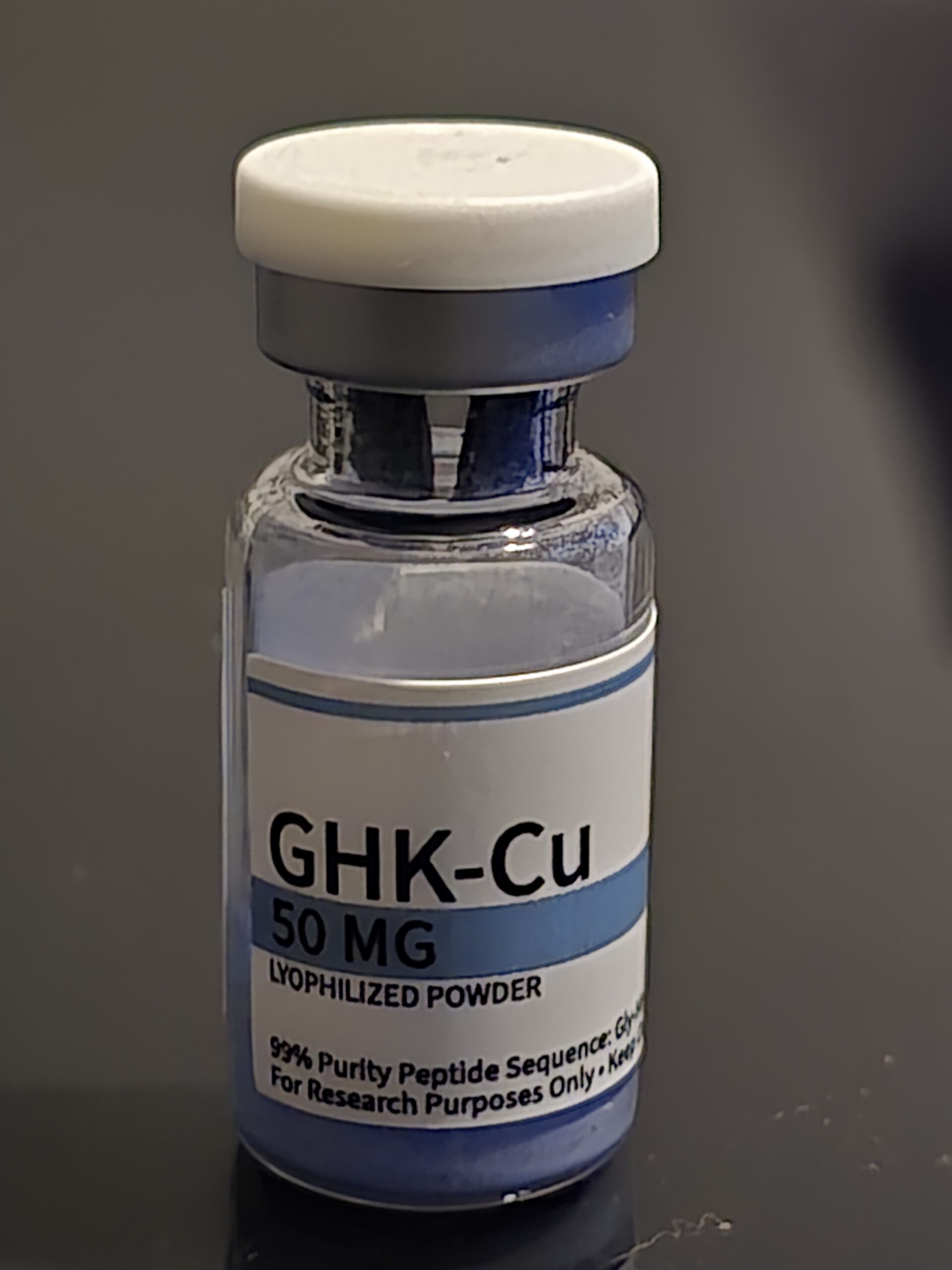
ZentraBio™ GHK-cu – 50 mg
Original price was: €40.00.€35.00Current price is: €35.00.
GHK-Cu 50 mg by ZentraBio is a high-purity, research-grade copper peptide studied for its role in regenerative signaling, gene expression modulation, extracellular matrix remodeling, and copper-dependent mitochondrial energy biology. Supplied in a precise 50 mg format, it is designed for controlled laboratory and investigational research use.
⚠️ For research use only. Not for human or veterinary use.
Description
GHK-Cu (Copper Tripeptide-1) — 50 mg by ZentraBio
Regenerative Signaling Peptide — Genetic, Mitochondrial, and Systemic Biology
Product Description
GHK-Cu (Copper Tripeptide-1) by ZentraBio is a high-purity, research-grade copper–peptide complex supplied as 50 mg of material for laboratory and investigational use. GHK-Cu (glycyl-L-histidyl-L-lysine bound to Cu²⁺) is a naturally occurring human peptide found in plasma, saliva, and urine, extensively studied for its role in regenerative signaling, gene expression modulation, extracellular matrix remodeling, immune regulation, and copper-dependent mitochondrial energy production.
Unlike peptides that act on a single receptor or pathway, GHK-Cu functions as a systems-level biological signal, influencing cellular behavior across connective tissue, nervous system, immune system, and metabolic infrastructure.
⚠️ For research use only. Not for human or veterinary use.
Medical & Educational Disclaimer
This page is for educational and informational purposes only and does not constitute medical advice, diagnosis, or treatment.
GHK-Cu supplied by ZentraBio is a research material, not a pharmaceutical product. Interpretations below are based on peer-reviewed literature and mechanistic biology.
Executive Summary
GHK-Cu is an endogenous copper-binding signaling peptide first identified during studies comparing healing capacity of young versus older human plasma (Pickart, 1973). Circulating levels decline substantially with age, correlating with reduced regenerative capacity and increased chronic inflammation.
Experimental literature demonstrates that GHK-Cu:
-
Modulates large gene-expression networks related to repair and inflammation
(Hong et al., 2010 — https://pubmed.ncbi.nlm.nih.gov/20195409/) -
Supports mitochondrial respiration via copper delivery to cytochrome-c oxidase
(Cobine et al., 2006 — https://pubmed.ncbi.nlm.nih.gov/17094761/) -
Regulates extracellular matrix turnover and wound healing
(Siméon et al., 2000 — https://pubmed.ncbi.nlm.nih.gov/10839759/) -
Modulates immune and mast-cell activity
(Finkley et al., 2014 — https://pubmed.ncbi.nlm.nih.gov/24958356/)
These findings position GHK-Cu as a foundational regenerative signal, not a cosmetic or single-pathway agent.
Endogenous Origin and Age-Related Decline
GHK-Cu was discovered in the early 1970s while investigating why young human plasma heals tissue more effectively than older plasma
(Pickart, 1973 — https://pubmed.ncbi.nlm.nih.gov/4513193/).
Subsequent analyses showed:
-
High circulating levels in young adults
-
Approximately 50–60 % decline between early adulthood and later life
(Pickart & Margolina, 2018 — https://pubmed.ncbi.nlm.nih.gov/29489959/)
This decline parallels:
-
Slower wound healing
-
Increased fibrosis
-
Mitochondrial inefficiency
-
Chronic low-grade inflammation
The regenerative machinery remains present; the signal diminishes.
Cellular Entry and Intracellular Signaling
GHK-Cu enters cells through receptor-mediated mechanisms involving pathways such as LRP-1, facilitating uptake and signaling initiation
(Campbell et al., 2014 — https://pubmed.ncbi.nlm.nih.gov/24641059/).
Once internalized, GHK-Cu activates conserved signaling cascades involved in:
-
Cell survival
-
Proliferation
-
Differentiation
-
Stress adaptation
(Siméon et al., 2000; Pickart & Margolina, 2018)
Nuclear Interaction and Gene Expression Modulation
A defining characteristic of GHK-Cu is its ability to enter the nucleus and directly influence gene expression
(Campbell et al., 2014 — https://pubmed.ncbi.nlm.nih.gov/24641059/).
Gene-expression profiling demonstrated:
-
Upregulation of genes involved in tissue repair, antioxidant defense, and differentiation
-
Downregulation of genes associated with inflammation, fibrosis, and apoptosis
-
Modulation of ~4,000 genes
(Hong et al., 2010 — https://pubmed.ncbi.nlm.nih.gov/20195409/)
This supports the concept that GHK-Cu restores youthful expression patterns, rather than forcing artificial cellular behavior.
Mitochondrial Function and ATP Production
Copper and the Electron Transport Chain
Copper is an essential component of cytochrome-c oxidase (Complex IV), the rate-limiting step of mitochondrial respiration
(Cobine et al., 2006 — https://pubmed.ncbi.nlm.nih.gov/17094761/).
Copper deficiency is associated with:
-
Reduced ATP production
-
Increased oxidative stress
-
Mitochondrial dysfunction
(Prohaska & Gybina, 2004 — https://pubmed.ncbi.nlm.nih.gov/15504543/)
Role of GHK-Cu
GHK-Cu has been shown to:
-
Deliver bioavailable copper intracellularly
-
Support mitochondrial enzyme activity
(Pickart, 2009 — https://pubmed.ncbi.nlm.nih.gov/19703507/) -
Increase expression of PGC-1α, promoting mitochondrial biogenesis
(Lee et al., 2012 — https://pubmed.ncbi.nlm.nih.gov/22340155/)
Extracellular Matrix Remodeling
GHK-Cu regulates ECM dynamics by:
-
Increasing collagen and elastin synthesis
-
Enhancing proteoglycan and glycosaminoglycan formation
(Siméon et al., 2000 — https://pubmed.ncbi.nlm.nih.gov/10839759/)
It also balances matrix metalloproteinases (MMPs) and their inhibitors (TIMPs), preventing both degeneration and fibrosis
(Maquart et al., 2004 — https://pubmed.ncbi.nlm.nih.gov/15154720/).
Inflammation and Immune Modulation
GHK-Cu reduces pro-inflammatory signaling by:
-
Suppressing NF-κB activation
-
Reducing IL-6 and TNF-α expression
(Park et al., 2015 — https://pubmed.ncbi.nlm.nih.gov/26097193/)
It enhances antioxidant enzyme expression (e.g., SOD, catalase) without suppressing immune competence
(Pickart & Margolina, 2018).
Mast-Cell Stabilization
GHK-Cu stabilizes mast cells, reducing histamine release and degranulation
(Finkley et al., 2014 — https://pubmed.ncbi.nlm.nih.gov/24958356/).
This mechanism explains its relevance in reactive inflammatory and dermatologic research contexts.
Nervous System and Neuro-Regenerative Context
Preclinical studies show that GHK-Cu:
-
Crosses the blood–brain barrier
(Jang et al., 2017 — https://pubmed.ncbi.nlm.nih.gov/28377438/) -
Increases NGF and BDNF signaling
-
Supports myelin-associated gene expression
(Campbell et al., 2013 — https://pubmed.ncbi.nlm.nih.gov/23553098/)
These findings remain investigational and preclinical.
Wound Healing (Strongest Evidence Base)
GHK-Cu has one of the most extensive peptide evidence bases in wound repair.
Findings include:
-
Faster wound closure
-
Improved tissue quality and reduced scarring
(Pickart, 2008 — https://pubmed.ncbi.nlm.nih.gov/18477636/) -
Enhanced healing in diabetic and impaired models
(Pickart et al., 2014 — https://pubmed.ncbi.nlm.nih.gov/25276442/)
Adaptation and Signal Regulation
Like all signaling molecules, prolonged continuous exposure can lead to:
-
Reduced receptor sensitivity
-
Diminished transcriptional response
(Pickart & Margolina, 2018)
For this reason, cycling paradigms are discussed in experimental contexts to preserve responsiveness.
Reported experimental and anecdotal research-use ranges (non-clinical)
⚠️ Important:
The following ranges reflect commonly discussed experimental / anecdotal patterns found across peptide dosing guides, clinic-style patient info PDFs, and healing/biohacking educational pages. They are not clinical recommendations and not evidence-based dosing standards.
Exploratory range (often described as “start low”)
- ~100–300 mcg per exposure
Sources that explicitly describe low-start approaches include:- Health Reclamation Project (starts at 100 mcg daily; titration language). (Health Reclamation Project)
- Poseidon Performance “peptide dosage guide” (lists 100–300 mcg ranges in a peptide dosing context). (Poseidon Performance)
Common “biohacker / longevity clinic” range
- ~1–2 mg per exposure, commonly referenced as daily or Mon–Fri
Repeated in multiple clinic-style and dosing-guide sources:- Happy Hormones MD patient info PDF (1–2 mg daily, Monday–Friday). (Happy Hormones MD)
- Peptide Initiative dosing guide (states 1–2 mg/day; also frames “systemic healing” as 1–2 mg daily). (Peptide Initiative)
- Alpa Bio Med dosing guide PDF (suggested dose 1–2 mg daily; notes “30 days on, 14 days off”). (HubSpot)
Upper experimental range (reported, not established)
- ~2–3 mg per exposure
Appears as titrated “target” ranges in dosing-protocol pages:- PeptideDosages.com protocol (titrates to 2.0 mg daily by later weeks). (peptidedosages.com)
- Genoracle “Doctor Sheet” PDF (suggests 2 mg daily). (GenOracle)
High-dose territory (commonly discussed, more controversial)
- ~5 mg per exposure (and sometimes higher)
Mentioned on some dosing guide pages as an upper end:- Peptide Initiative guide explicitly references “1–5 mg” SQ research doses. (Peptide Initiative)
Frequency and cycling patterns commonly mentioned (anecdotal)
- Daily exposure is the most common pattern in dosing guides and clinic sheets. (Happy Hormones MD)
- Weekday-only (Mon–Fri) shows up in clinic-style materials. (Happy Hormones MD)
- Cycling is commonly suggested in some guides, for example:
- “30 days on, 14 days off” (explicitly stated in Alpa Bio Med dosing guide). (HubSpot)
These cycles are convention-based (signal management / adherence / tolerance) rather than validated clinical requirements.
Notes (warnings & interpretation)
- Human dose-response data are not established for injected GHK-Cu in the way online dosing guides imply. (Even “doctor sheet”/clinic PDFs are practice patterns, not outcome-validated standards.) (Happy Hormones MD)
- Effects are context-dependent (skin/hair vs systemic repair narratives; baseline inflammation; copper status). (Peptide Initiative)
- Copper exposure is the unique variable: higher-dose/long-duration discussions frequently include cautions about “more isn’t always better.” (Peptide Initiative)
- Chronic exposure has unknown long-term consequences (no robust human outcomes literature defining optimal duration/frequency). (Peptide Initiative)
Research-Context Exposure / Dosage Ranges (Educational Only)
⚠️ Not clinical guidance. The following are published in-vitro / animal study exposures used to contextualize mechanistic literature, and they do not translate directly to human dosing.
1) In-vitro (cell culture) ranges
- ~1–10 μM GHK-Cu used in an inflammatory macrophage model with reported changes in oxidative stress and inflammatory signaling under that model’s conditions. (Oncotarget article text.) (JustAnswer)
2) In-vivo (animal) examples
- ~1–10 mg/kg (example cited in the same LPS/inflammatory injury discussion context). (JustAnswer)
Important warnings for interpretation
- These are model-specific exposures, not human equivalents.
- GHK vs GHK-Cu, formulation, route, and copper status materially change outcomes. (Peptide Initiative)
- Human outcome data for systemic disease modification remains not established (strongest evidence is mechanistic/preclinical + topical/dermal contexts). (Peptide Initiative)
Evidence Interpretation
Well-supported:
-
Endogenous origin and age-related decline
-
Gene-expression modulation
-
ECM remodeling
-
Copper-dependent mitochondrial support
-
Anti-inflammatory and mast-cell effects
Investigational:
-
Long-term systemic disease modification in humans
-
Neurodegenerative and lifespan outcomes
Final Perspective
GHK-Cu is not cosmetic, not a single-target drug, and not a surface-level intervention. It is a core biological signal involved in regeneration, energy production, and inflammatory balance across multiple systems.
Its relevance lies in restoring communication, not overriding physiology.
Related products
-
Sale!
ZentraBio™ Retatrutide – 10 x 10 mg Vial
Original price was: €810.00.€660.00Current price is: €660.00. Add to cart Compare -
Sale!
Wegovy 4 mg by GenPep
Original price was: €138.00.€105.00Current price is: €105.00. Add to cart Compare -
Sale!
ZentraBio™ GHK-cu – 5 X 50 mg
Original price was: €190.00.€150.00Current price is: €150.00. Add to cart Compare -
Sale!
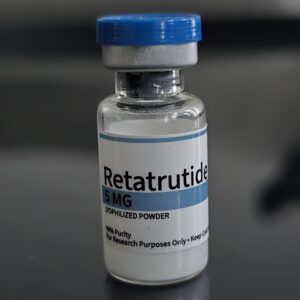
ZentraBio™ Retatrutide – 4 x 5 mg Vial
Original price was: €208.00.€173.00Current price is: €173.00. Add to cart Compare
Reviews
There are no reviews yet.